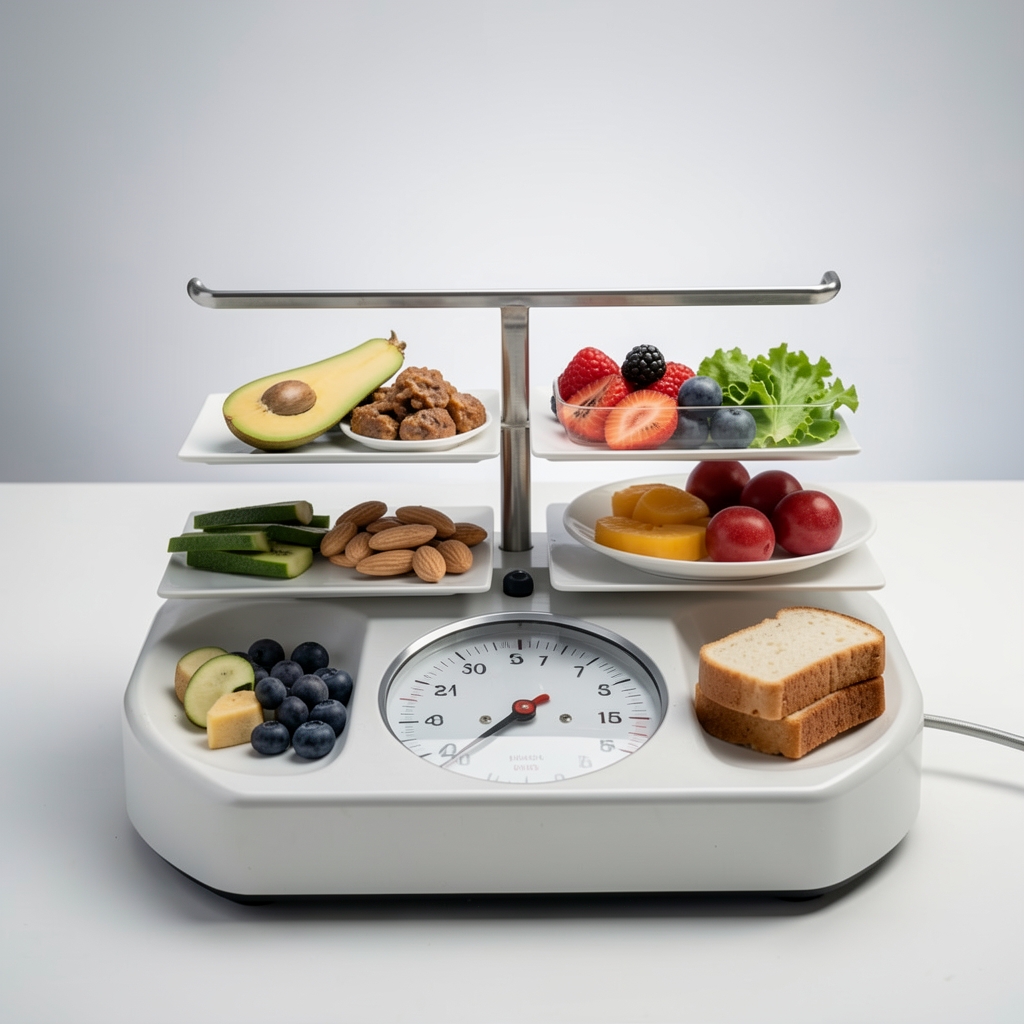
Each meal initiates a complex sequence of metabolic events. Absorbed carbohydrates enter circulation as glucose; dietary fat arrives in lymph before reaching systemic blood; amino acids from protein digestion follow the portal route to the liver. What happens next — the allocation of these substrates to oxidation, storage, structural use, or further conversion — is what researchers refer to as nutrient partitioning. The pattern is not fixed. It shifts with the physiological state at the time of eating, the composition of the meal, recent activity, and the individual's current metabolic context.
Key Observations
- Carbohydrate oxidation takes priority over fat oxidation when glucose is available.
- Insulin sensitivity is a primary determinant of how efficiently glucose reaches muscle tissue.
- Protein is not a preferred energy substrate — it is directed preferentially toward structural and enzymatic roles.
- Post-meal fat storage in adipose tissue is largely governed by physiological signalling rather than direct dietary fat intake alone.
- Timing of carbohydrate relative to activity meaningfully influences which compartments receive substrate.
The Priority Hierarchy in Substrate Oxidation
The body operates a clear hierarchy in fuel selection following a mixed meal. Alcohol, when present, is oxidised preferentially above all other substrates — the liver has no storage capacity for ethanol and must clear it first. Carbohydrate oxidation takes second priority, driven by circulating glucose and the need to maintain plasma levels within a narrow range. Fat oxidation is suppressed during carbohydrate abundance. Protein oxidation sits at the base of the priority stack, directed away from energy use when carbohydrate supply is adequate.
This hierarchy has immediate practical consequences. In a post-meal state following a carbohydrate-containing meal, dietary fat is not oxidised at meaningful rates — it is directed instead to adipose tissue for storage pending a future period when carbohydrate is less available. The popular notion that consuming dietary fat is the primary driver of adipose accumulation conflates direct fat intake with the regulatory logic of substrate allocation. The actual partition of fat to storage is heavily mediated by the carbohydrate-driven insulinemic environment in which the meal is consumed.
This does not render dietary fat composition unimportant. The structural and signalling roles of specific fatty acids — in membrane phospholipids, eicosanoid precursors, and related pathways — are well established in published literature. The point is simply that the fate of dietary fat cannot be read from its intake in isolation; it must be understood within the context of the complete metabolic environment at the time of consumption.
Insulin Sensitivity and the Routing of Glucose
Insulin is the primary coordinating signal in post-meal nutrient allocation. Released from the pancreatic beta cells in proportion to circulating glucose (with protein intake providing a smaller secondary stimulus), insulin orchestrates the uptake of glucose into peripheral tissues, particularly skeletal muscle and adipose tissue. In muscle, glucose enters the glycolytic pathway for immediate oxidation or is converted to glycogen for storage. In adipose tissue, insulin promotes triglyceride synthesis from available substrates.
Insulin sensitivity — the efficiency with which target tissues respond to insulin signalling — is a central variable in determining how cleanly this routing occurs. In an individual with high insulin sensitivity, a modest insulin signal effectively routes glucose to muscle and liver glycogen, with relatively little spill into adipose synthesis pathways. In an individual with reduced insulin sensitivity, higher circulating insulin is required to achieve the same glucose clearance, and the prolonged insulinemic state promotes more extensive lipogenic activity.
London, March 2026 — Field notes reviewed by Eleanor Whitfield, Senior Contributing Editor.
Nutrient partitioning is not determined at the moment of eating. It is the outcome of a state the body was already in before the first bite was taken.
The Role of Glycogen Status
Muscle glycogen status at the time of eating is one of the most reliably documented modulators of post-meal nutrient partitioning. In a state of glycogen depletion — following sustained aerobic activity, a period without carbohydrate intake, or an overnight fast — the muscle cell exhibits heightened insulin sensitivity and elevated glucose transporter expression. The same carbohydrate intake will therefore produce a substantially different partition outcome depending on whether it is consumed in a depleted or replete glycogen state.
This is the mechanistic basis for the widely observed benefit of consuming carbohydrate in proximity to physical activity. Post-exercise carbohydrate ingestion occurs at the moment of maximal muscle receptivity — the routing efficiency is high, and the proportion directed to liver and adipose pathways is comparatively low. The same absolute carbohydrate intake consumed in a sedentary state, with muscle glycogen already replete, will be handled differently. The quantity of carbohydrate matters; the context in which it is consumed matters equally.
Protein Partitioning: Synthesis, Oxidation, and the Role of Leucine
Protein presents the most nuanced partitioning profile of the three macronutrients. Unlike carbohydrate and fat, protein has no dedicated storage form. Absorbed amino acids enter the systemic circulation as a mixture of twenty standard molecules, each with distinct downstream metabolic roles. The liver removes a portion for gluconeogenesis, urea synthesis, and the production of acute-phase and transport proteins. The remainder enters peripheral circulation, available for uptake by muscle, connective tissue, and other protein-synthesising cells.
The signal for muscle protein synthesis is dominated by the essential amino acid leucine. Research indicates that there is a threshold concentration of leucine required to maximally stimulate the mechanistic target of rapamycin complex 1 (mTORC1) pathway — the primary intracellular signal for protein synthesis initiation. Below this threshold, additional protein intake does not further stimulate synthesis. Above it, the response is robust but not proportionally greater with increasing dose. This has direct implications for how total daily protein intake should be distributed across eating occasions — the evidence favours a distribution across multiple meals rather than a single large intake.
Excess amino acids beyond immediate synthetic needs and the liver's processing capacity are directed toward oxidation, with the nitrogen fraction excreted as urea. Protein carries a thermic cost of twenty to thirty per cent of its caloric value through this processing — the highest of any macronutrient. The usable energy yield from a gram of dietary protein is therefore substantially lower than the nominal four kilocalories per gram figure suggests under conditions of excess intake.
Practical Implications for Macro Balance
The observed variability in nutrient partitioning across individuals and contexts has several practical implications for macro balance and portion structure. First, the glycaemic response to a given carbohydrate intake varies considerably between individuals — a finding documented extensively in continuous glucose monitoring research. Second, timing relative to activity meaningfully alters substrate routing without changing total intake. Third, insulin sensitivity — modifiable through activity, sleep quality, and dietary composition — is one of the most accessible levers for improving partitioning efficiency over time.
What emerges from the field record is a picture of nutrient partitioning as a dynamic process rather than a fixed biochemical outcome. The body is continuously re-routing substrate according to a hierarchy of priorities that reflects both immediate conditions and the accumulated history of the individual's metabolic environment. An approach to macro balance that accounts for this dynamic — distributing protein across eating occasions, timing carbohydrate relative to activity, and attending to the glycogen state — is more likely to align intake with actual metabolic capacity than one based on total daily quantities alone.

Tobias Ashcroft is a contributing editor and guest writer at Terlano Compendium, focusing on the mechanics of nutrient metabolism and substrate utilisation. His editorial work draws on current research in metabolic physiology and applied nutritional science.
More from this author →